
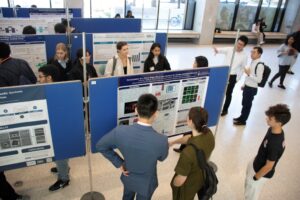
 There is a large breadth of research that takes place at U of T, and the Undergraduate Research Explorer is just one way to see the diverse scope of undergraduate research opportunities available. Each summer, hundreds of U of T Engineering students gain research experience working in labs on campus and across the world. Summer is a great time to gain practical experience in a mentored environment where you can focus on defining problems and identifying solutions.
Are you interested in participating in summer research? Do you have a question about the opportunities available to you? Check out the FAQs below to learn more about incorporating summer research into your engineering studies!
For general questions, please contact the Engineering Experiential Learning Coordinator, Undergraduate Research and Global Experiences at undergrad.research@engineering.utoronto.ca.
Research FAQs
Summer research is a great opportunity to help you determine if research is for you (or not for you!). Working with your professors and classmates in the summer helps you to network and make new connections. Summer research can also be used towards your Practical Experience Requirement for your degree. It may also qualify for PEY Co-Op – contact the Engineering Career Centre to learn more.
Many summer research opportunities are highlighted on the Undergraduate Research Webpage.
You can look up professors/researchers and the projects they are working on. Start by reviewing a department's website to learn about the research they are conducting. You can also visit Discover Research to view faculty profiles from across U of T. You can search beyond U of T and look for research opportunities outside of Toronto or Canada as well.
Read up on the projects and the work done by the professor to see if you are interested in gaining experience in that area. Some departments may post summer research opportunities on their website. Select research projects that you are interested in and contact the professor or research team.
There are also some specific programs at U of T that involve research which you can consider exploring/applying to. Research Programs are structured opportunities at U of T with a focus on research, including The Engineering Science Research Opportunities Program (ESROP) and the Work Study Program: Research Experience Stream. Participating in Research Abroad is also available, such as through the Summer Research Exchange Program or the RISE-Globalink Research Internship.
The best way to contact researchers/professors is by email in late December or early January. It is advised to include your CV or resume, unofficial transcript, and highlight any connections that you may have to them (professor of your class) and/or their research area (brief sentence(s) on work you may have done related to the research area).
Write a professional email that introduces you, indicates your intentions and asks if you can meet to talk about working with them in the summer. Contact multiple professors/researchers; you don’t need to limit yourself to emailing just one. However, tailor your email and make it specific to the researcher and/or project. The email doesn’t need to be very long but should provide enough details for them to understand your interest.
To get your resume ready, there are lots of resources available to help you. You’re Next Career Network (YNCN) holds a Resume Hack Event as part of their Fall and Winter Career Fair.
You can review Career Exploration & Education’s Resume and Cover Letter Toolkit (PDF) to get started, or book a Resume Ready appointment with one of their career peer advisors. The Career Learning Network is also a great place to sign up for resume workshops and for additional resources and support.
YNCN(opens in new tab) and Career Exploration & Education(opens in new tab) are great resources that can help you to learn how to interview well. To learn more about general interview tips, consider reviewing Career Exploration & Education’s Get Help With Interviewing(opens in new tab). That said, please remember: this may not be a typical job interview. It is primarily about being interested in a professor/researcher’s work and how you would like to have the chance to work with them. Before your interview or meeting, be sure to review projects that they have worked on in the past or are currently working on.
Grades may have an impact, and some professors may request a copy of your transcript. However, there are additional factors professors and researchers consider when hiring students for summer research opportunities.
Don’t worry if you do not secure a summer research position. Throughout your time at U of T, there will be multiple opportunities for you to build/gain hands-on experience.
If you’re looking to take advantage of the four-month summer period to be productive and get involved, there are many options you can pursue, including getting a summer job, volunteering, participating in a design team, designing your own project, and finding additional opportunities to gain skills and knowledge.
While there is no set deadline for when to contact professors, the best time to start is in late December or early January. Other deadlines to note include applying for research scholarships and awards (generally in January/February).
Scholarships and awards for research are a way of compensating you for the work and time you have spent on the summer research opportunity. The deadlines to apply for scholarships and awards range from January to March.
Undergraduate Summer Research Awards administered at the Faculty of Applied Science & Engineering can be found on our website, but additional funding can be sought via ESROP (Engineering Science), IBBME, exchange programs for international research, a professor/supervisor's grant funding and Department-specific summer research awards.
Make learning objectives for yourself and keep a weekly list of what you achieved. Take advantage of the opportunity to work closely with professors and researchers by remaining curious, asking lots of questions, and asking for specific feedback to help you improve your research skills.
You can participate in the Undergraduate Summer Research Program. Weekly sessions are held for participants to learn success skills that enhance their research experience and form a community of student researchers. Following this, you can present your research work at the Undergraduate Engineering Research Day (UnERD). This event gives undergraduates the opportunity to share their achievements from their summer research in an academic showcase.